Insights · Content strategy
How content strategy pricing works: project vs retainer, and what drives the cost
You are not buying hours or a document. You are buying decisions your team can act on, and that is what the price should track.
Content strategy pricing is hard to compare because agencies are rarely quoting for the same thing. One proposal covers an audit and a slide deck. Another covers research, a roadmap and a year of reviews. Both are called a content strategy.
This guide explains how strategy engagements are priced, what actually drives the cost, when a one-off project fits and when a retainer does, and the questions to ask any agency, including us. It is written from how we scope our own content strategy services, but it applies to any proposal on your desk.
You will not find a number here. We explain why in the section on cost. What you will find is a way to read a quote so you know what you are paying for.
Why content strategy pricing varies so much
Three things make quotes hard to compare.
Different deliverables under the same name. "Content strategy" can mean a list of blog topics, a full audit with a journey map, or an ongoing planning function. Until you see the deliverables listed, you cannot compare the fee.
Different starting points. A company with a large library of old content needs a bigger audit than one starting from a handful of pages. A company selling to one buyer needs less research than one selling to a buying committee.
Different pricing models. Some agencies price per project, some on a monthly retainer, and some quote for time spent rather than for what you receive. Each is legitimate. They just answer different questions.
There is also a behavioural reason buyers find this uncomfortable. People tend to avoid options whose outcome they cannot judge, a pattern known as ambiguity aversion (Ellsberg, 1961). A vague quote feels riskier than a clear one, even when the work behind it is similar. A good proposal removes that ambiguity by naming what you get.
What you are paying for: content strategy deliverables
A complete strategy makes five decisions. We set these out in more detail in content strategy vs content marketing, but in short, the content strategy deliverables are:
- An audit: keep, update, merge or remove, per asset.
- Pillars: the few themes your brand can credibly own.
- A journey map: each buyer's questions and doubts, stage by stage.
- A roadmap: what to build, in what order.
- Governance: who briefs, approves and reviews the plan.
These usually come together in a content strategy document, plus working files your team can edit: an audit spreadsheet, a journey map and a roadmap. A polished PDF that nobody can update is a weaker deliverable than a plain spreadsheet your team uses every week.
If a proposal leaves one of the five out, ask whether that is deliberate. Sometimes it is: you may already have a recent audit. Sometimes it is a gap that will cost you later.
The five cost drivers: scope, audiences, research depth, channels, governance
Each driver below maps to one or more of the five decisions. That is the clearest way to see why one quote differs from another.
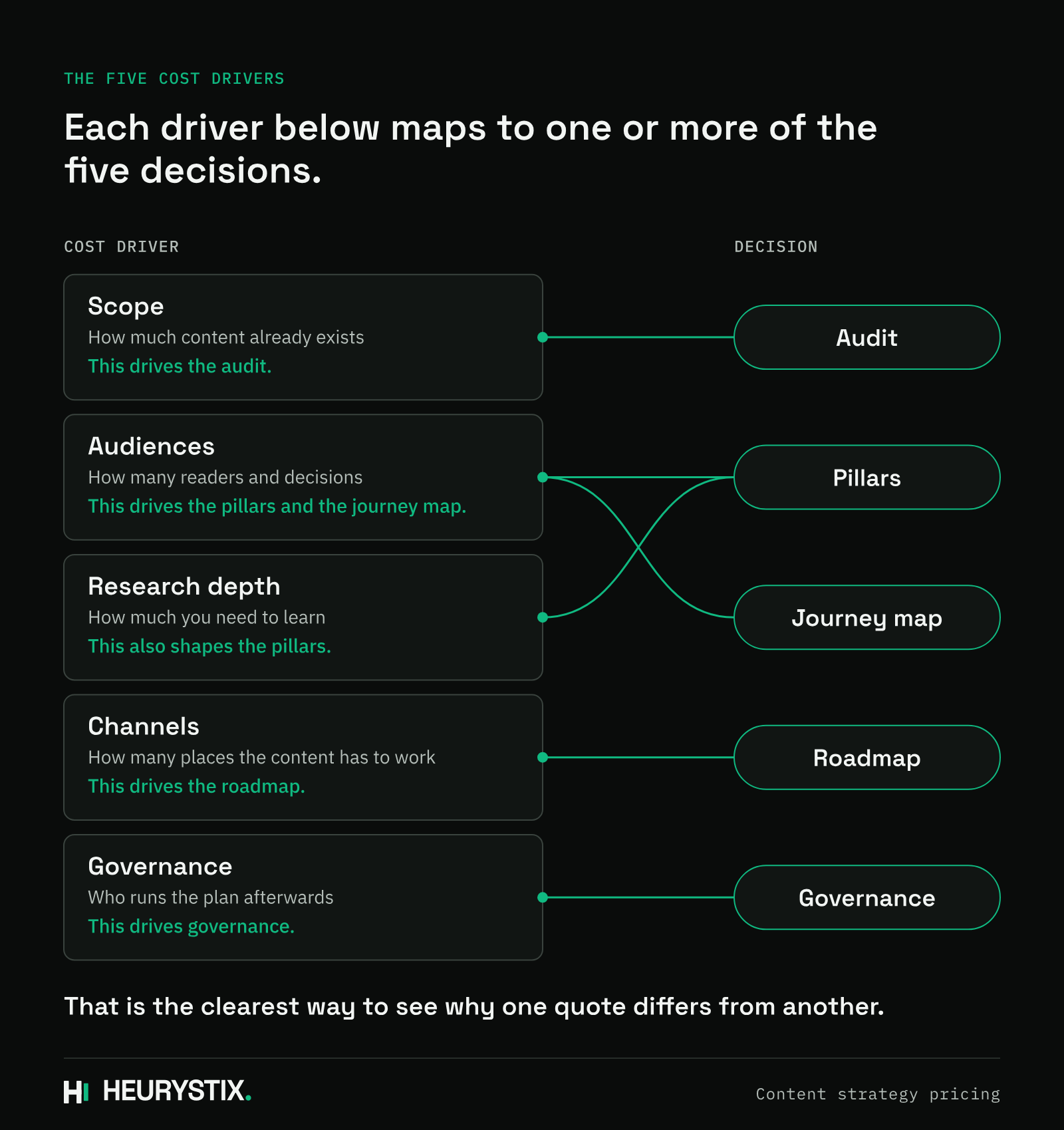
Scope: how much content already exists
This drives the audit. A site with a few dozen pages can be audited quickly. A site with years of blog posts, product pages, help articles, sales decks and email sequences takes far longer, because every asset has to be read and judged, not just counted.
Audiences: how many readers and decisions
This drives the pillars and the journey map. One product sold to one kind of buyer gives you one journey. Several product lines sold to finance, IT and procurement give you several journeys that have to fit together. Each extra audience adds research, mapping and messaging.
Research depth: how much you need to learn
This also shapes the pillars, because a pillar needs a claim you can prove. Some teams already have customer interviews, sales call notes and win-loss data. Others are starting from assumptions. Interviewing customers, listening to sales calls and reviewing competitors all take time, and all make the strategy sharper.
Channels: how many places the content has to work
This drives the roadmap. A strategy for a website and a newsletter is simpler than one that also covers LinkedIn, sales enablement, partner content and paid campaigns. Each channel needs a job, a format and a place in the sequence.
Governance: who runs the plan afterwards
This drives governance, and it often decides whether you need a project or a retainer. If your team will run the plan, governance means clear roles, briefing templates and a review rhythm. If the plan needs to be reviewed and revised every month, governance becomes an ongoing service.
Regulated sectors add to this driver. In BFSI and healthcare, claims review has to be built into the workflow from day one, and that takes planning.
Project or retainer: which fits your stage
Text version
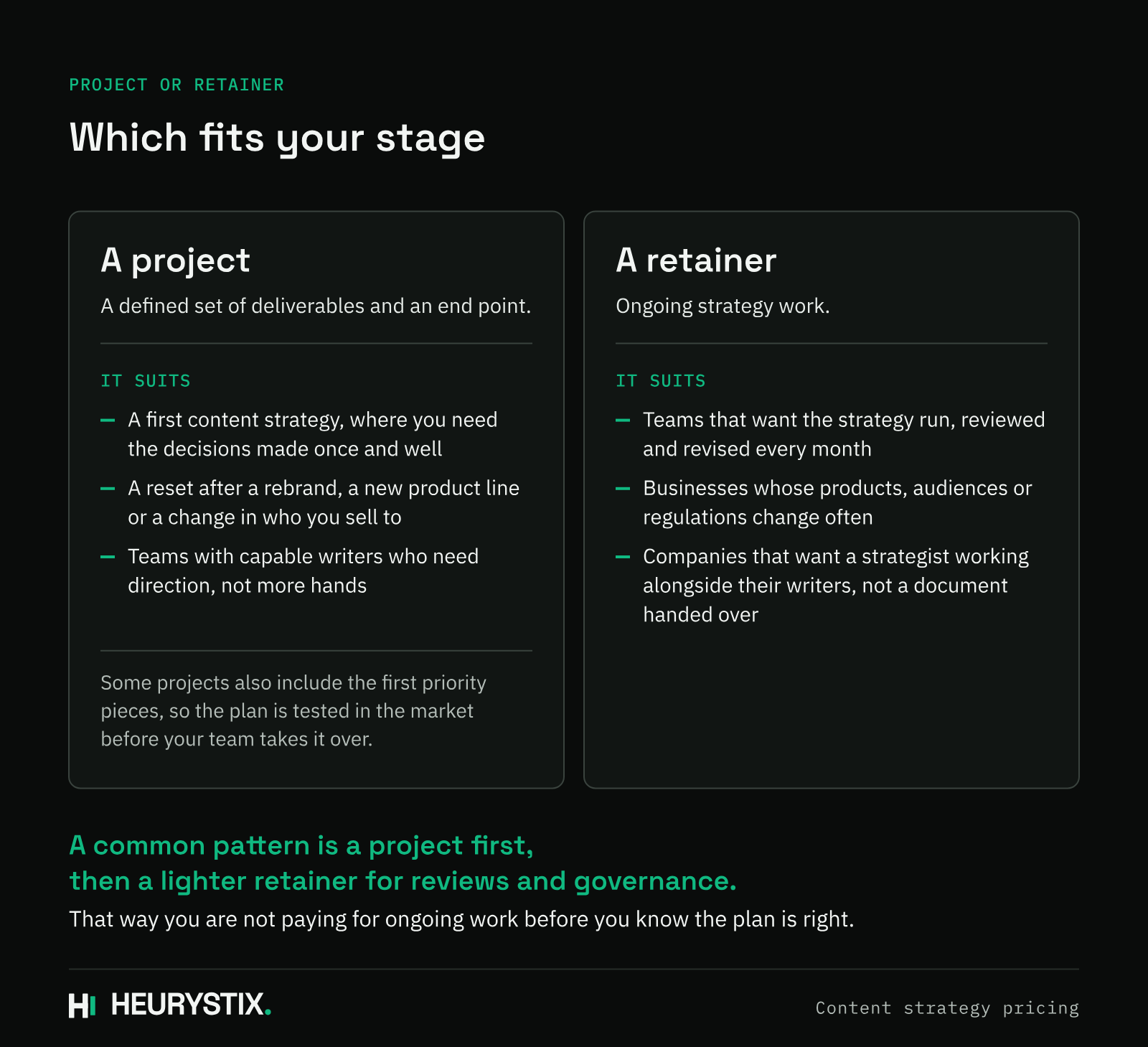
A project has a defined set of deliverables and an end point. It suits:
- a first content strategy, where you need the decisions made once and well;
- a reset after a rebrand, a new product line or a change in who you sell to;
- teams with capable writers who need direction, not more hands.
Some projects also include the first priority pieces, so the plan is tested in the market before your team takes it over.
A retainer covers ongoing strategy work. It suits:
- teams that want the strategy run, reviewed and revised every month;
- businesses whose products, audiences or regulations change often;
- companies that want a strategist working alongside their writers, not a document handed over.
A common pattern is a project first, then a lighter retainer for reviews and governance. That way you are not paying for ongoing work before you know the plan is right.
What a good content strategy proposal shows
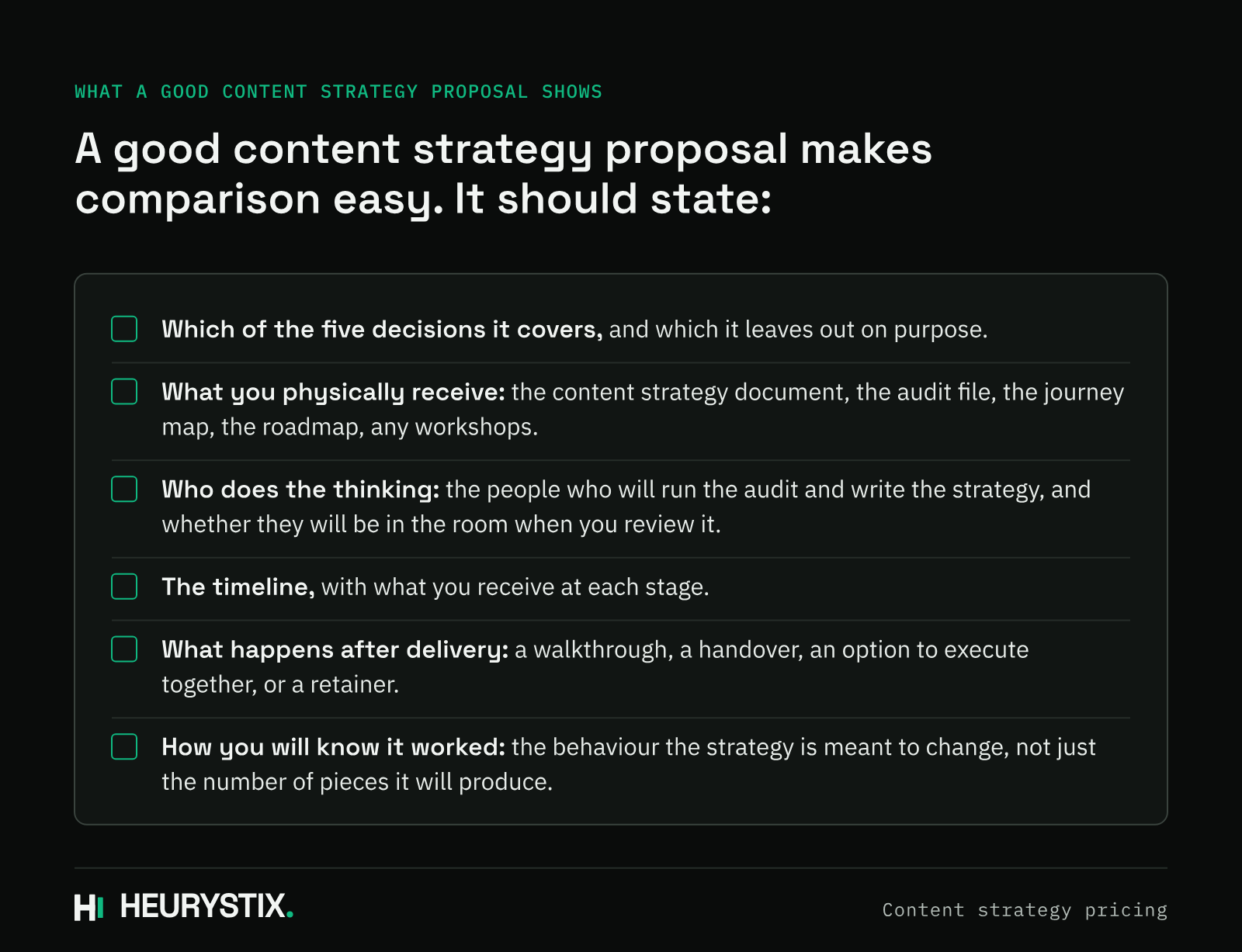
A good content strategy proposal makes comparison easy. It should state:
Text version
- Which of the five decisions it covers, and which it leaves out on purpose.
- What you physically receive: the content strategy document, the audit file, the journey map, the roadmap, any workshops.
- Who does the thinking: the people who will run the audit and write the strategy, and whether they will be in the room when you review it.
- The timeline, with what you receive at each stage.
- What happens after delivery: a walkthrough, a handover, an option to execute together, or a retainer.
- How you will know it worked: the behaviour the strategy is meant to change, not just the number of pieces it will produce.
Be wary of a proposal that leads with output, such as a number of blog posts a month, without saying which decisions sit behind them. That is a content marketing quote dressed as a strategy.
Timelines deserve a second look. People reliably underestimate how long work will take, even work they have done before (Buehler, Griffin and Ross, 1994). A proposal that builds in time for your team's reviews is more honest than one that assumes instant approvals.
How much does content strategy cost? Why we don't publish a number
The honest answer to "how much does content strategy cost?" is that it depends on the five drivers above. If you need a budget figure before talking to anyone, ask two or three agencies to quote against the same list of decisions; the spread will tell you more than any published rate. Two companies of the same size can need very different strategies.
We also avoid publishing a number for a behavioural reason. The first figure people see tends to anchor their judgement of everything after it (Tversky and Kahneman, 1974). A published number would anchor the conversation before anyone knows your scope, and you would end up comparing a figure instead of comparing what each agency would actually decide for you.
So we do it the other way round. At Heurystix, pricing is set per project or retainer after a first conversation with the founders. We agree scope first, then the fee, so you know the full cost before you commit.
Questions to ask any agency before you sign
- Which of the five decisions does this proposal cover, and why are any missing?
- What will we receive, and in what format can our team edit it?
- Who will do the audit and the research, and will we meet them?
- How many audiences and channels have you scoped for?
- What research will you do, and what do you need from us?
- How do you handle claims review in our sector?
- Is this a project or a retainer, and what would make you recommend the other?
- What happens if our scope changes halfway through?
- What does the handover look like, and who runs the plan afterwards?
- How will we know the strategy worked?
If you are also commissioning the copy that follows a strategy, the same logic applies to writers. Our guide on how copywriters charge covers the models for that work. Content strategy is one of several content services we offer, and the thinking behind all of them is on our page about behavioural economics in marketing.
FAQs: content strategy pricing
Why don't you publish content strategy prices?
Because the cost depends on scope: how many audiences, how deep the research goes, how many channels, and who runs the plan afterwards. We agree scope and fee after a first conversation with the founders, so you know the full cost before you commit.
What is included in a content strategy document?
An audit of what you have, the few content pillars your brand can own, a journey map of each buyer's questions and doubts, a roadmap of what to build and in what order, and governance: who briefs, approves and reviews the plan.
Is a retainer better than a one-off project?
A project suits a first strategy or a reset. A retainer suits teams that want the strategy run, reviewed and revised every month.
How long does a content strategy take?
It depends on the scope. A good proposal states the timeline and what you receive at each stage, so you can hold the agency to it.
Want a scoped proposal for your business? A first conversation with a founder is the place to start.
Sources
- Buehler, R., Griffin, D. and Ross, M. (1994). Exploring the "planning fallacy": why people underestimate their task completion times. Journal of Personality and Social Psychology, 67(3).
- Ellsberg, D. (1961). Risk, ambiguity, and the Savage axioms. Quarterly Journal of Economics, 75(4).
- Tversky, A. and Kahneman, D. (1974). Judgment under uncertainty: heuristics and biases. Science, 185(4157).