Insights · Content strategy
Content strategy vs content marketing: the difference that decides ROI
Strategy decides. Marketing does. Get the order wrong and you pay for content twice.
Most debates about content strategy vs content marketing treat them as two names for the same job. They are not. Content strategy decides what to say, to whom and in what order. Content marketing does the saying: it writes, publishes, distributes and measures.
The difference matters because it decides where your money goes. A team that markets without a strategy is not saving the cost of strategy. It is paying for it later, in content that has to be rewritten, retired or explained away. That is the thinking behind our content strategy services: decide first, then build.
This piece sets out the difference, shows one illustrative Indian B2B example, and explains why the sequence, not the volume, is what moves return on investment.
The difference between content marketing and content strategy
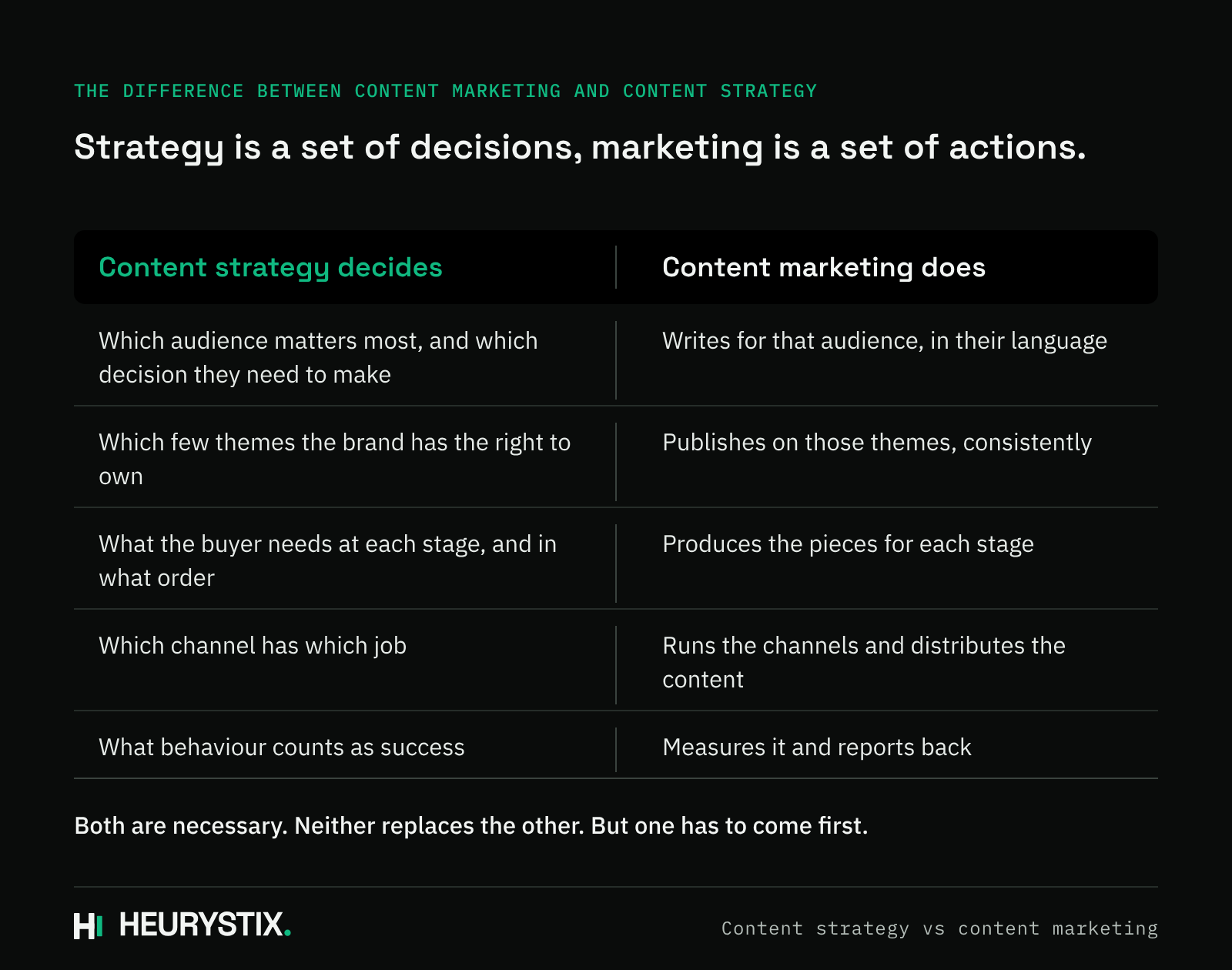
Here is the simplest way to put the difference between content marketing and content strategy: strategy is a set of decisions, marketing is a set of actions.
Text version
| Content strategy decides | Content marketing does |
|---|---|
| Which audience matters most, and which decision they need to make | Writes for that audience, in their language |
| Which few themes the brand has the right to own | Publishes on those themes, consistently |
| What the buyer needs at each stage, and in what order | Produces the pieces for each stage |
| Which channel has which job | Runs the channels and distributes the content |
| What behaviour counts as success | Measures it and reports back |
Both are necessary. Neither replaces the other. But one has to come first, and that is where most teams go wrong.
You will also see a third term, content marketing strategy. It is the marketing slice of content strategy: why you use content to win and keep customers, and for whom. Content strategy is wider. It covers all of a company's content, including product, help and website copy, and how that content is created, published and maintained.
Why teams start with marketing anyway
Marketing is visible. A blog post, a LinkedIn carousel or a webinar can be shown to a manager by Friday. A strategy is a set of decisions, and decisions are harder to show off. So teams default to doing, because doing feels like progress.
There is a behavioural pattern underneath this. People tend to prefer a visible, immediate result over a delayed one, even when the delayed one is worth more. Behavioural economists call this present bias (O'Donoghue and Rabin, 1999). In content, that shows up as a full publishing calendar and a pipeline that does not move.
What goes into a content strategy
If you are wondering what goes into a content strategy, the answer is five things:
- An audit of what already exists, scored against the decision each asset should support.
- Pillars: the few themes your brand can credibly own, each tied to a buyer problem and a provable claim.
- A journey map: the question, the doubt and the answer at each stage, from first contact to signed contract.
- A roadmap: what gets built, in what order, for which stage and channel.
- Governance: who briefs, writes, approves and checks claims, and how the plan is reviewed.
Notice that none of these is a piece of content. They are the decisions that make every later piece easier to brief, quicker to approve and more likely to work. Get them right once, and every brief after them gets shorter.
Content marketer vs content strategist: two different jobs
The roles split the same way. In the content marketer vs content strategist question, the clearest test is what each one is accountable for.
A content strategist is accountable for the decisions. Who are we talking to? What do we want them to do? What do they need to believe first? What should we stop publishing? The strategist's best work often looks like saying no.
A content marketer is accountable for execution. Is the piece good? Did it ship on time? Did it reach the right people? Did they act on it? The marketer's best work looks like consistent, high-quality output that compounds.
In a small team, one person often does both. That is fine, as long as they know which hat they are wearing. The trouble starts when the strategy hat never goes on, and every week begins with "what should we post?" rather than "what decision are we moving?"
An Indian B2B example, sequenced
Here is an illustrative example, not client work, to show how sequence changes the job.
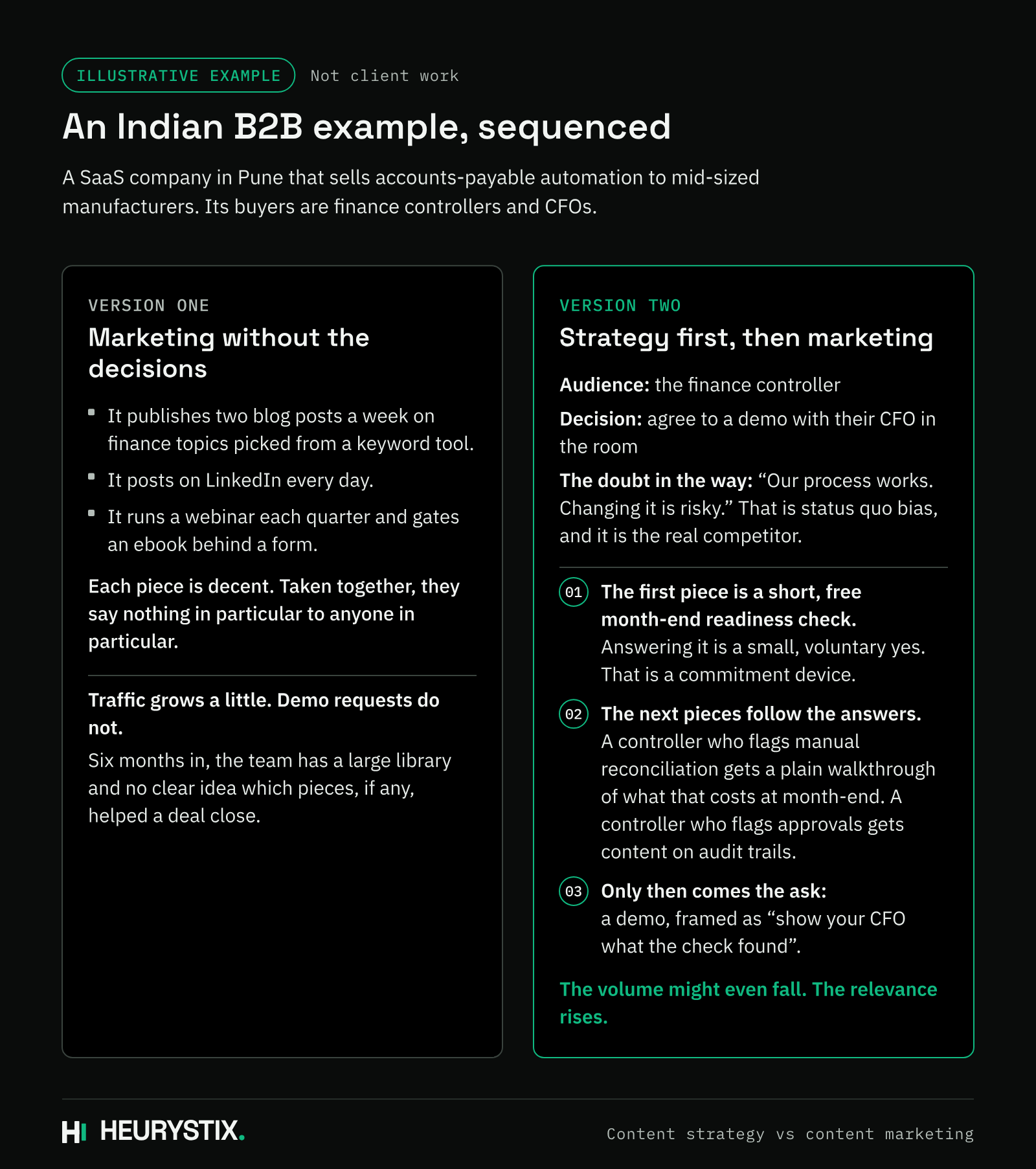
Picture a SaaS company in Pune that sells accounts-payable automation to mid-sized manufacturers. Its buyers are finance controllers and CFOs who have run month-end close the same way for years. They are not unhappy enough to go looking for software.
Version one: marketing without the decisions
The team does what most teams do. It publishes two blog posts a week on finance topics picked from a keyword tool. It posts on LinkedIn every day. It runs a webinar each quarter and gates an ebook behind a form. Each piece is decent. Taken together, they say nothing in particular to anyone in particular.
Traffic grows a little. Demo requests do not. Sales complains that leads are students and job seekers. Six months in, the team has a large library and no clear idea which pieces, if any, helped a deal close.
Version two: strategy first, then marketing
Now the same team starts by deciding.
- Audience: the finance controller, because the controller feels the month-end pain first and brings it to the CFO.
- Decision: agree to a demo with their CFO in the room.
- The doubt in the way: "Our process works. Changing it is risky." That is status quo bias (Samuelson and Zeckhauser, 1988), and it is the real competitor.
- Sequence: a small first step before any big ask.
So the roadmap changes shape. The first piece is a short, free month-end readiness check: a handful of questions a controller can answer in a few minutes, with no sales call attached. Answering it is a small, voluntary yes. That yes works as a commitment device: having said "our close has these gaps", the controller may find the next, consistent step easier to take. The foot-in-the-door effect was first reported by Freedman and Fraser (1966); later reviews found it real but modest, and dependent on how the first request is framed (Burger, 1999).
The next pieces follow the answers. A controller who flags manual reconciliation gets a plain walkthrough of what that costs at month-end, framed around time and errors they recognise. A controller who flags approvals gets content on audit trails. Only then comes the ask: a demo, framed as "show your CFO what the check found".
The team still writes blog posts and still posts on LinkedIn. That is the content marketing. But every piece now has a place in a sequence and a job to do. The volume might even fall. The relevance rises.
This is what we mean by sequencing with behavioural science. We write more about commitment devices, loss aversion and choice architecture on our page on behavioural economics in marketing.
Why the order decides ROI
Return on content depends on two things: what each piece costs, and what each piece moves. Marketing without strategy tends to drive up the first and leave the second to chance.
Text version
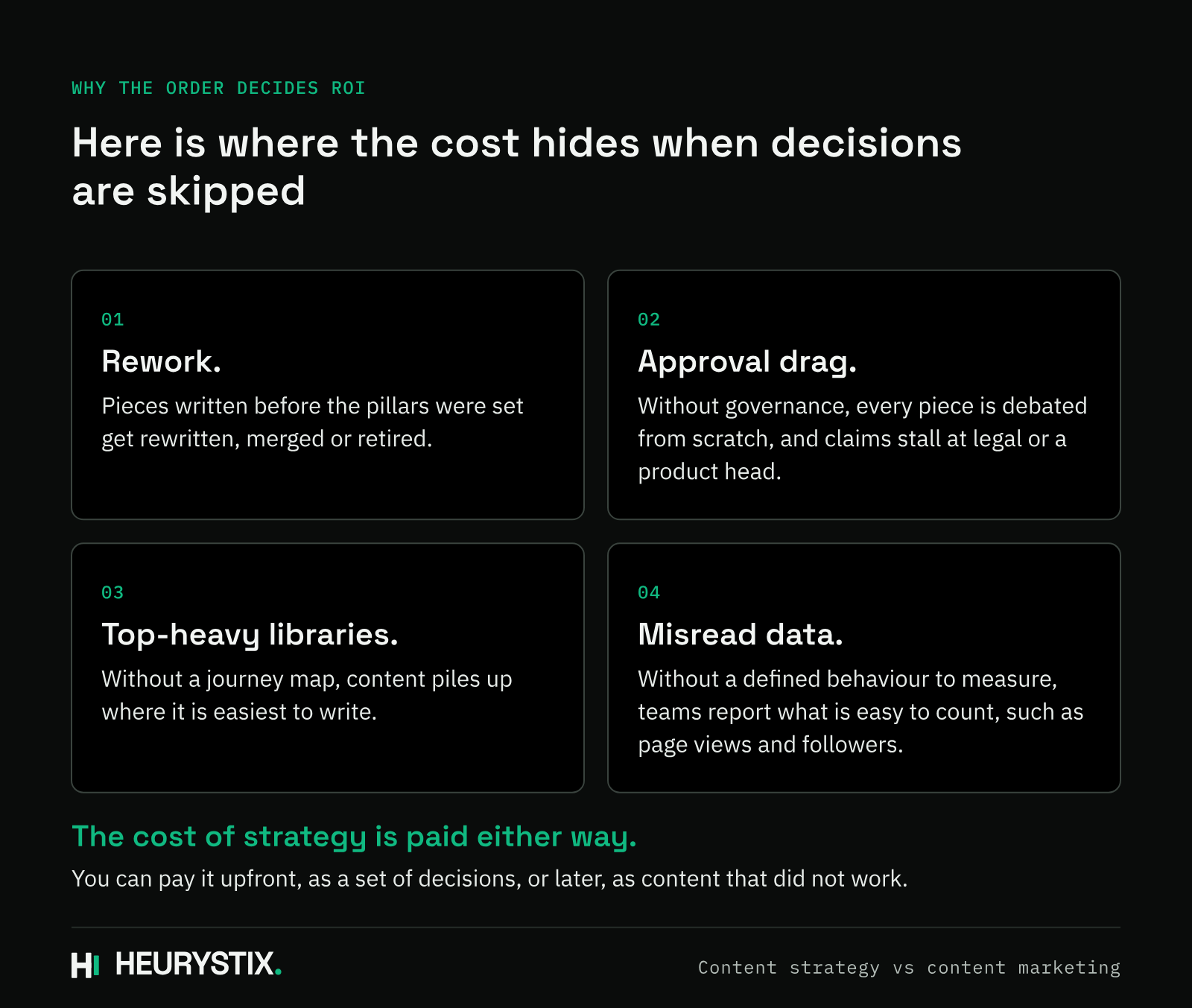
Here is where the cost hides when decisions are skipped:
- Rework. Pieces written before the pillars were set get rewritten, merged or retired once someone finally decides what the brand stands for.
- Approval drag. Without governance, every piece is debated from scratch, and claims stall at legal or a product head.
- Top-heavy libraries. Without a journey map, content piles up where it is easiest to write: broad awareness topics that rarely move a buyer who is already comparing options.
- Misread data. Without a defined behaviour to measure, teams report what is easy to count, such as page views and followers, and the budget conversation turns into a debate about vanity metrics.
None of this means strategy is expensive and marketing is cheap. It means the cost of strategy is paid either way. You can pay it upfront, as a set of decisions, or later, as content that did not work.
So which should you buy first?
If you have no clear answer to "who is this for, and what should they do next?", start with strategy. If you have a strategy your team trusts and the problem is output, start with marketing.
Many teams sit somewhere in between, with some decisions made and others missing. A first conversation is usually enough to tell which. If the problem is the words on one page, start with how to hire a copywriter. If the question is budget, read how content strategy pricing works.
Content strategy is one of several content services we offer, alongside brand strategy, content marketing, conversion content, writing and editing, and social media marketing. We price each per project or per retainer, agreed after that first conversation.
FAQs: content strategy vs content marketing
Is a content marketing strategy the same as a content strategy?
Not quite. A content marketing strategy covers why you use content to win and keep customers, and for whom. A content strategy is wider: it governs all of a company's content, including product, help and website copy, and how that content is created, published and maintained.
What is the difference between a content strategy and a content plan?
A content strategy is the set of decisions: the audience, the pillars, the journey and what counts as success. A content plan, or content calendar, is the schedule that carries those decisions out: what gets published, when, on which channel and by whom. A plan without a strategy is a calendar of guesses.
What is the difference between a content strategist and a copywriter?
A content strategist decides what content should exist, for whom and in what order. A copywriter writes the words for a specific piece so that the reader acts. One person can do both, but the work is judged differently: the strategist by whether the plan moves a decision, the copywriter by what readers do after reading.
Should content strategy come before content marketing?
Usually, yes. If you cannot say who your content is for and what they should do next, start with strategy. If you already have a strategy your team trusts and the problem is output, start with content marketing.
Sources
- Burger, J. M. (1999). The foot-in-the-door compliance procedure: a multiple-process analysis and review. Personality and Social Psychology Review, 3(4).
- Freedman, J. L. and Fraser, S. C. (1966). Compliance without pressure: the foot-in-the-door technique. Journal of Personality and Social Psychology, 4(2).
- O'Donoghue, T. and Rabin, M. (1999). Doing it now or later. American Economic Review, 89(1).
- Samuelson, W. and Zeckhauser, R. (1988). Status quo bias in decision making. Journal of Risk and Uncertainty, 1(1).