Insights · Conversion content
How copywriters charge: per word, per project or retainer
A headline of ten words can carry the whole decision. Pay for the thinking, not the word count.
If you are comparing quotes and asking "how do copywriters charge?", the short answer is: in one of three ways. Per word, per project or on a retainer. The longer answer is that the model matters less than what it pays for, and for copy that has to sell, some models fit far better than others.
This guide explains each model, why per-word pricing fails conversion copy, what a project fee should cover, when a retainer makes sense and what to ask before you accept a quote. It reflects how we scope our own conversion copywriting, but the questions work for any writer or agency.
There are no figures here. Pricing depends on the job, and we explain what moves it.
How do copywriters charge? The three models
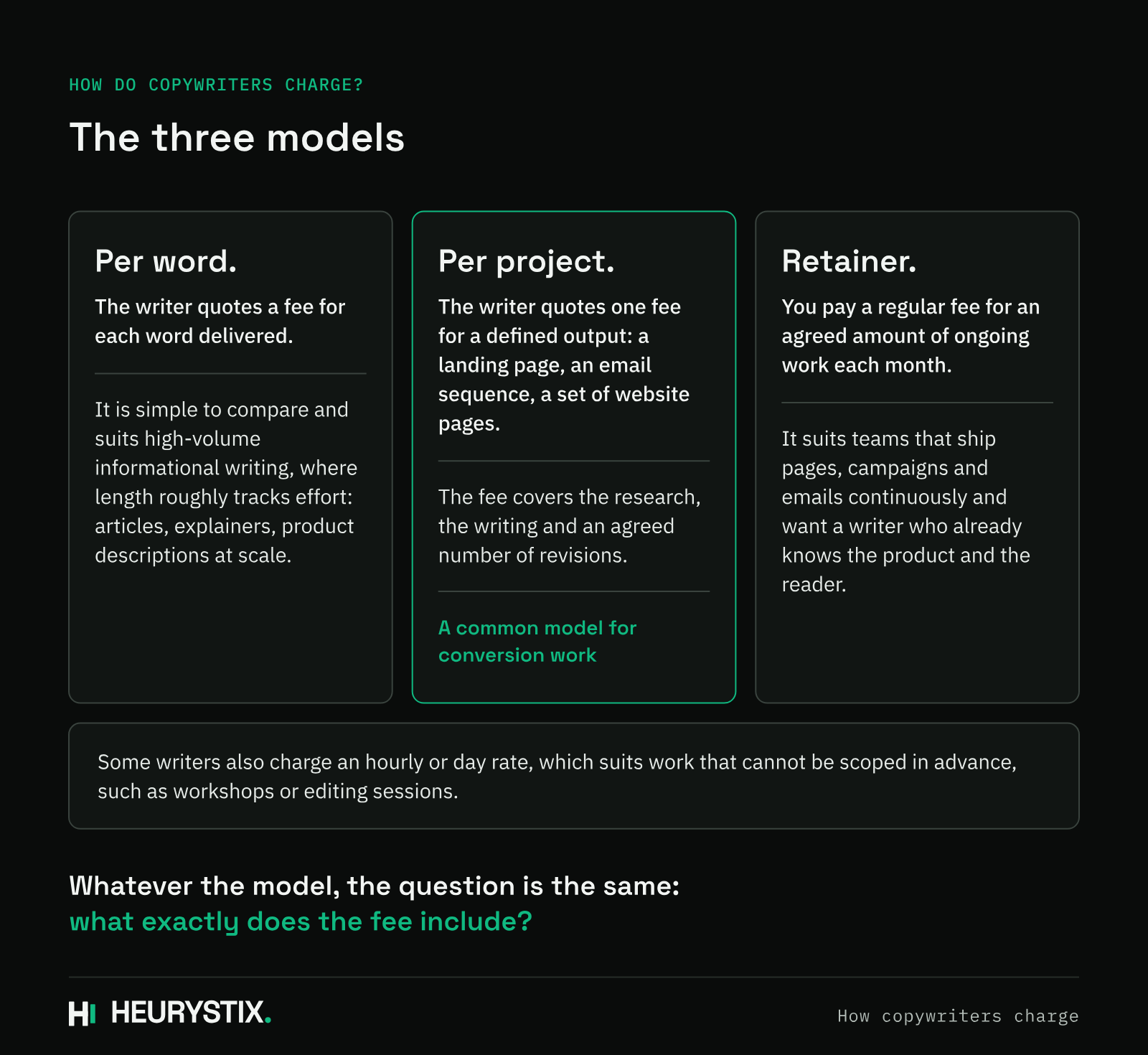
Per word. The writer quotes a fee for each word delivered. It is simple to compare and suits high-volume informational writing, where length roughly tracks effort: articles, explainers, product descriptions at scale.
Per project. The writer quotes one fee for a defined output: a landing page, an email sequence, a set of website pages. The fee covers the research, the writing and an agreed number of revisions. This is a common model for conversion work, and the one that fits it best.
Retainer. You pay a regular fee for an agreed amount of ongoing work each month. It suits teams that ship pages, campaigns and emails continuously and want a writer who already knows the product and the reader.
Many writers combine models: a project for the first landing page, then a retainer for the tests and pages that follow. That is often the sensible route, because the project shows you how the writer thinks before you commit to ongoing work.
Some writers also charge an hourly or day rate, which suits work that cannot be scoped in advance, such as workshops or editing sessions. Whatever the model, the question is the same: what exactly does the fee include?
Why per-word pricing fails conversion copy
On a landing page, the words that do the most work are often the fewest. A headline, a sub-head, the button and the line beneath it might add up to a few dozen words. They decide whether the reader stays, scrolls or leaves.
Getting those few words right takes research into the buyer, a clear view of the doubt that stops them and several drafts tested against each other. None of that shows up in a word count. Per-word pricing pays the writer more for adding words and nothing for cutting them, which is the opposite of what conversion copy needs.
There may be a behavioural trap on the buyer's side too. One set of studies found that people rated work more highly when they believed more effort had gone into it (Kruger, Wirtz, Van Boven and Altermatt, 2004). Our inference, not theirs: a long document looks like more work than a short page with sharp lines, so buyers can end up paying for length when they wanted results.
Picture two quotes for the same landing page, as an illustrative example. One writer prices the words on the finished page. The other prices the work: customer calls, a review of competitor pages, a mechanism map and a set of headline variants. The first quote is easier to read. The second tells you what you are paying for.
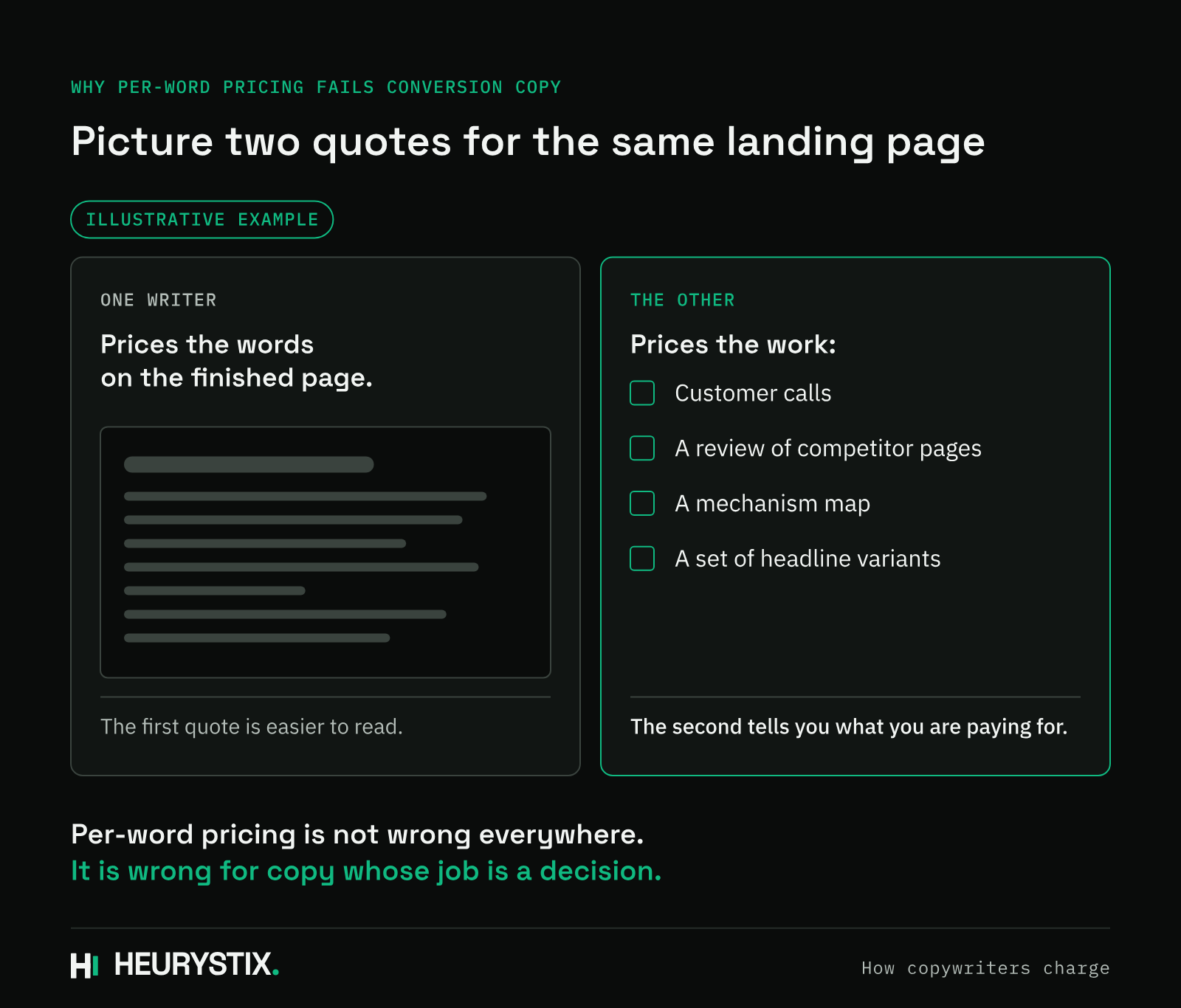
Per-word pricing is not wrong everywhere. It is wrong for copy whose job is a decision.
What a project fee should cover: research, mechanism, drafts, test variants
A project fee for conversion copy should buy four things. If a quote does not mention them, ask.
Research. Customer interviews or call notes, reviews, support tickets, competitor pages and a conversation with your sales team. This is where the writer finds the reader's real doubt, in the reader's own words.
Mechanism mapping. A decision about which behavioural mechanism each section relies on, such as loss aversion in the headline, a small first step in the form, or specific proof near the button. Good writers can explain these choices; we set out the ones we use on our page about behavioural economics in marketing, and you can see them labelled line by line in our conversion copywriting examples.
Drafts and revisions. An agreed number of drafts and revision rounds, with a clear definition of what counts as a round.
Test variants. Alternative headlines or offers you can test against each other, where your traffic allows. A single version with no alternatives leaves you nothing to learn from.
When a copywriter retainer makes sense
A copywriter retainer makes sense when:
- you launch pages, campaigns or emails every month, not once a quarter;
- your product, offers or regulations change often, so copy needs regular updates;
- you want one writer, or one team, to build up knowledge of your reader over time;
- you run tests and need someone to write the next variant as each result comes in.
It makes less sense for a single launch or one underperforming page. A project fits better there, and it is a good way to test fit before committing to anything ongoing.
A retainer also changes how the writer works. Instead of starting cold each time, they carry what they learned from the last test into the next draft.
Ask what a retainer includes each month, how unused work is handled and how either side can change the scope.
Landing pages, emails, websites: how the job changes the scope
Different jobs need different amounts of thinking, which is why one quote rarely fits all of them.
Landing pages. If you are asking how much do copywriters charge for a landing page, the honest answer is that it depends on the research and the decision, not the length. A page for a cold audience from paid ads needs more work on doubt and proof than a page for existing customers.
Email and WhatsApp sequences. The scope depends on the number of messages, the branches in the sequence and how each message hands over to the next. A sequence is one argument told in parts, so it needs planning before writing.
Product and pricing pages. Short pages with high stakes: the reader is close to a decision, and every line near the button matters. The scope depends on how many plans or options need explaining, and how carefully the choice has to be presented.
Websites. A full website involves several pages, each with its own reader and decision, plus navigation labels and microcopy. The scope grows with the number of pages and with how many people need to approve them.
Copywriting charges in India: what moves a quote up or down
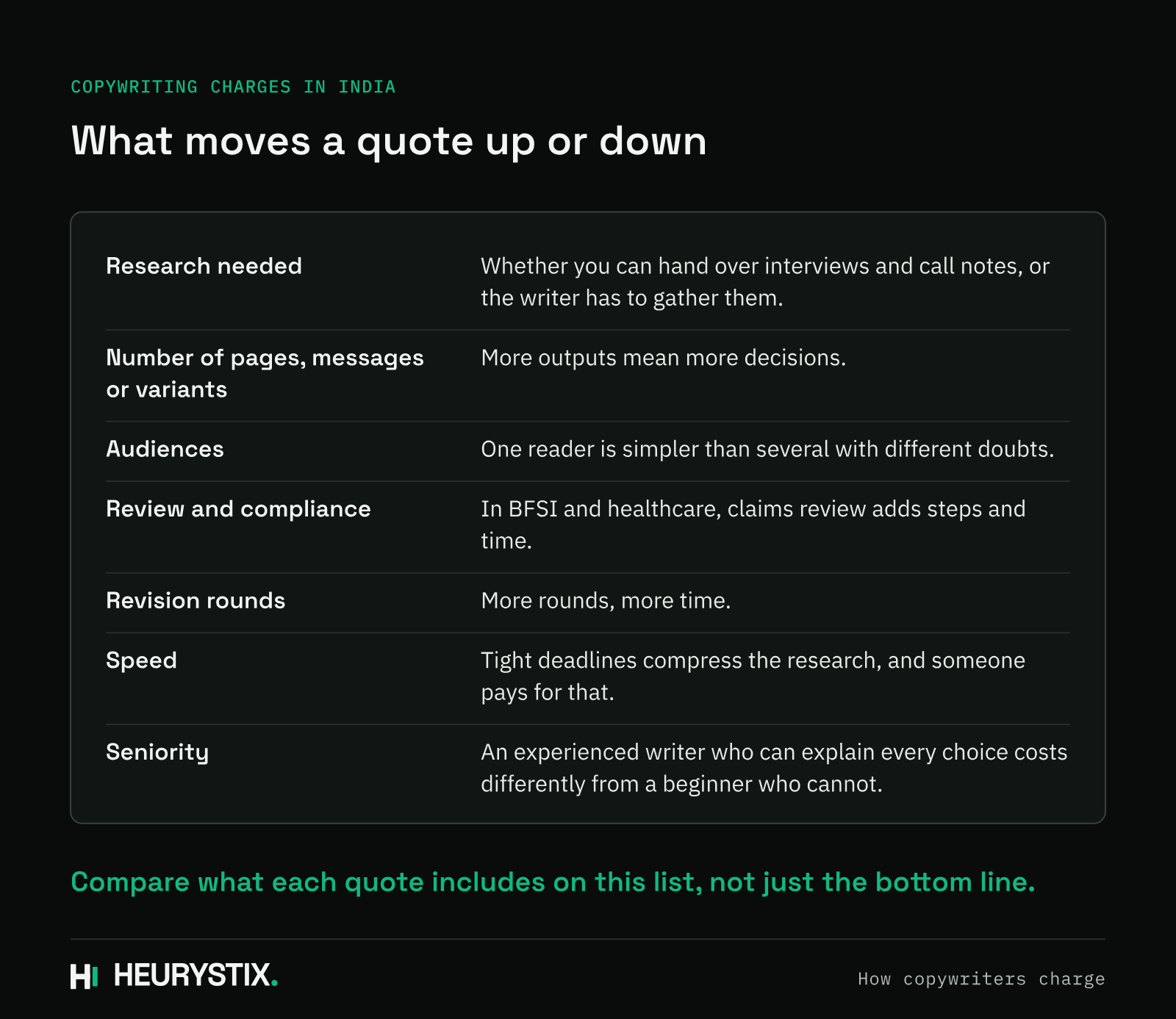
Copywriting charges in India vary widely, and the reasons are usually the same. A quote goes up or down with:
Text version
- Research needed: whether you can hand over interviews and call notes, or the writer has to gather them.
- Number of pages, messages or variants: more outputs mean more decisions.
- Audiences: one reader is simpler than several with different doubts.
- Review and compliance: in BFSI and healthcare, claims review adds steps and time.
- Revision rounds: more rounds, more time.
- Speed: tight deadlines compress the research, and someone pays for that.
- Seniority: an experienced writer who can explain every choice costs differently from a beginner who cannot.
When you compare copywriting pricing, compare what each quote includes on this list, not just the bottom line. A low quote is not always a bad one, but it usually saves time somewhere, most often in research. Ask where.
Questions to ask before you accept a quote
- What research is included, and what do you need from us?
- How will you decide which mechanism each section uses?
- How many drafts and revision rounds are included, and what counts as a round?
- Will we get variants we can test?
- Who will actually write the copy?
- What happens if the scope changes?
- What is not included?
For the full list of questions to ask before you hire, see our guide on how to hire a copywriter. If you are pricing a content strategy as well, how content strategy pricing works covers that side.
At Heurystix, pricing is set per project or retainer after a first conversation with the founders. Conversion copy is one of several content and copy services we offer.
FAQs: how copywriters charge
Why don't you publish copywriting rates?
Because the right fee depends on the job: the research needed, the number of pages or sequences, and whether you want test variants. We agree scope and fee after a first conversation with the founders.
Is per-word pricing ever the right model?
Yes, for high-volume informational writing where length tracks effort. It is the wrong model for conversion copy, where a ten-word headline can carry the whole decision.
What should a quote for landing page copy include?
Research into the buyer and the decision, the mechanism each section relies on, at least one round of revisions, and headline or offer variants you can test.
Do copywriters charge for revisions?
Most include a set number of revision rounds in the project fee. Ask how many are included and what counts as a revision before you sign.
Need conversion copy for a page that has to sell? A first conversation with a founder is the place to start.
Sources
- Kruger, J., Wirtz, D., Van Boven, L. and Altermatt, T. W. (2004). The effort heuristic. Journal of Experimental Social Psychology, 40(1).