Insights · Conversion content
How to hire a copywriter: 12 questions to ask before you sign
The best copywriter for you is the one who can explain why a line works, not just write it.
Most advice on how to hire a copywriter starts with portfolios: scroll the samples, pick what sounds good, ask for a proposal. But sounding good is not the job. A landing page, an email or a product page asks someone to make a decision, and the writer you hire should be able to tell you how their words help that decision along.
This guide is built the way we run our own conversion copywriting work: decision first, words second. It covers which kind of hire fits, twelve questions to ask a copywriter before you sign, portfolio red flags and a one-page brief to send.
How to hire a copywriter: start with the decision, not the writer
Before you speak to anyone, write one sentence: "After reading this, I want the reader to..." Book a demo. Start a trial. Request a callback. Forward the page to their manager.
If you cannot finish that sentence, no copywriter can fix the page, however talented. You will get polished words pointed at nothing, and judge them on taste.
It also tells you what help you need. If you know the reader and the decision, you need a writer. If you are unsure who the page is for, you have a strategy question first, which we unpack in content strategy vs content marketing.
Freelancer, agency or in-house: which fits the job
The twelve questions below work for all three. The answers you should expect differ.
A freelancer often suits a single landing page or a short email sequence, where one sharp writer can hold the whole job in their head. Ask about availability around your launch.
An agency makes sense when the copy depends on decisions not yet made, or when you need several writers working to one standard. Ask who reviews the work before you see it.
An in-house writer suits teams with a steady flow of copy and a product that changes often. Ask candidates how they would build a research habit inside the company, not just how they write.
Whichever you choose, hire for the decision, not the deliverable.
12 questions to ask a copywriter before you sign
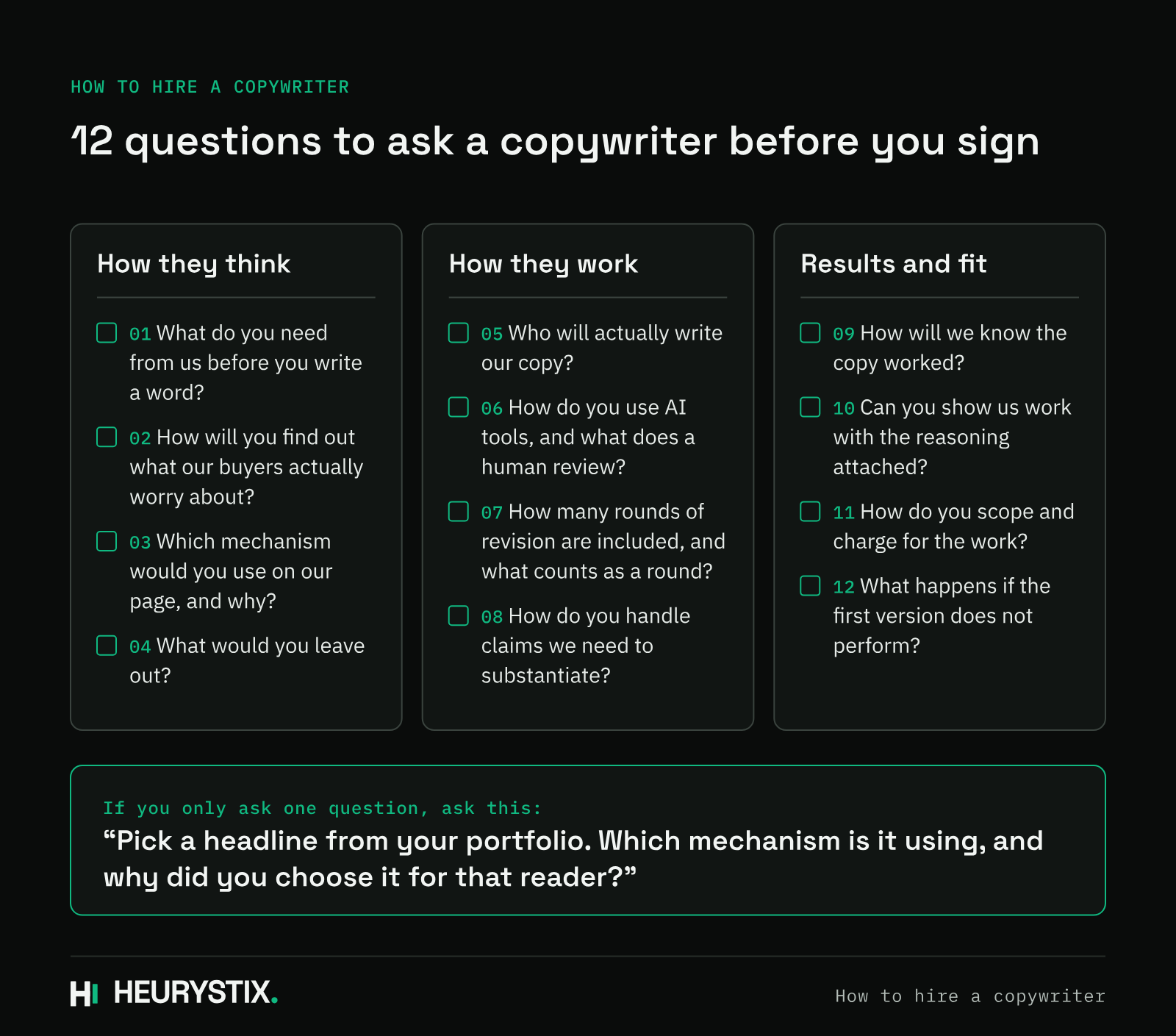
How they think
1. What do you need from us before you write a word? Good copywriters ask for research: customer interviews, sales call notes, support tickets and reviews. If they ask only for brand guidelines and a word count, they plan to write from the outside in.
2. How will you find out what our buyers actually worry about? Listen for specific methods, such as reading competitor reviews, talking to your sales team or listening to recorded calls with permission.
3. Which mechanism would you use on our page, and why? This is the test question, explained below, applied to your situation. A good answer will be provisional but reasoned.
4. What would you leave out? Restraint is a skill. A writer who can tell you what does not belong on the page usually understands what does.
How they work
5. Who will actually write our copy? The person in the pitch is not always the person at the keyboard. Ask to meet the writer.
6. How do you use AI tools, and what does a human review? There is no single right answer, but there should be a clear one: who is accountable for every claim on your page?
7. How many rounds of revision are included, and what counts as a round? Vague revision terms cause friction late in a project. Agree them in writing.
8. How do you handle claims we need to substantiate? This matters most in BFSI and healthcare, where a line that sounds great can fail review.
Results and fit
9. How will we know the copy worked? The answer should be a behaviour: clicks on the main call-to-action, form completions, replies. Be wary of anyone promising a specific lift before seeing your page.
10. Can you show us work with the reasoning attached? Annotated drafts tell you more than a polished portfolio.
11. How do you scope and charge for the work? Ask what is included, what counts as extra and what happens if the scope changes. Our guide to how copywriters charge explains the common models. And ask who will own the copy once you have paid (see the FAQ below).
12. What happens if the first version does not perform? A good partner plans for testing and iteration, not a single handover.
The question that separates writers: which mechanism does this headline use?
If you only ask one question, ask this:
"Pick a headline from your portfolio. Which mechanism is it using, and why did you choose it for that reader?"
A strong answer names something specific. Perhaps the headline frames what the reader loses by waiting, because people weigh a loss more heavily than an equal gain (loss aversion; Kahneman and Tversky, 1979). Perhaps it shows the reader what people like them already do, because people tend to move towards what their peers do (social norms; Schultz et al., 2007). Home energy reports that compared each household with its neighbours reduced energy use across very large field trials (Allcott, 2011). An illustrative headline, usable only if it is true: "Most finance teams your size have stopped closing the month on spreadsheets." Perhaps it offers a small first step because the full ask was too big for a cold visitor, since agreeing to a small request can make a bigger one easier, an effect that reviews find real but modest and dependent on how the first request is framed (the foot-in-the-door effect; Freedman and Fraser, 1966; Burger, 1999). The vocabulary matters less than the reasoning: a reader, a doubt and a deliberate choice.
A weak answer talks about tone, rhythm or "what the client liked". That describes how a line sounds, not why it works.
It also exposes a writer who is talented but guessing. Guesses can land; they just cannot be repeated on purpose. We set out the mechanisms we write with on our page about behavioural economics in marketing, and show them at work in conversion copywriting examples, annotated by mechanism.
Red flags in a portfolio: what to watch for
Text version
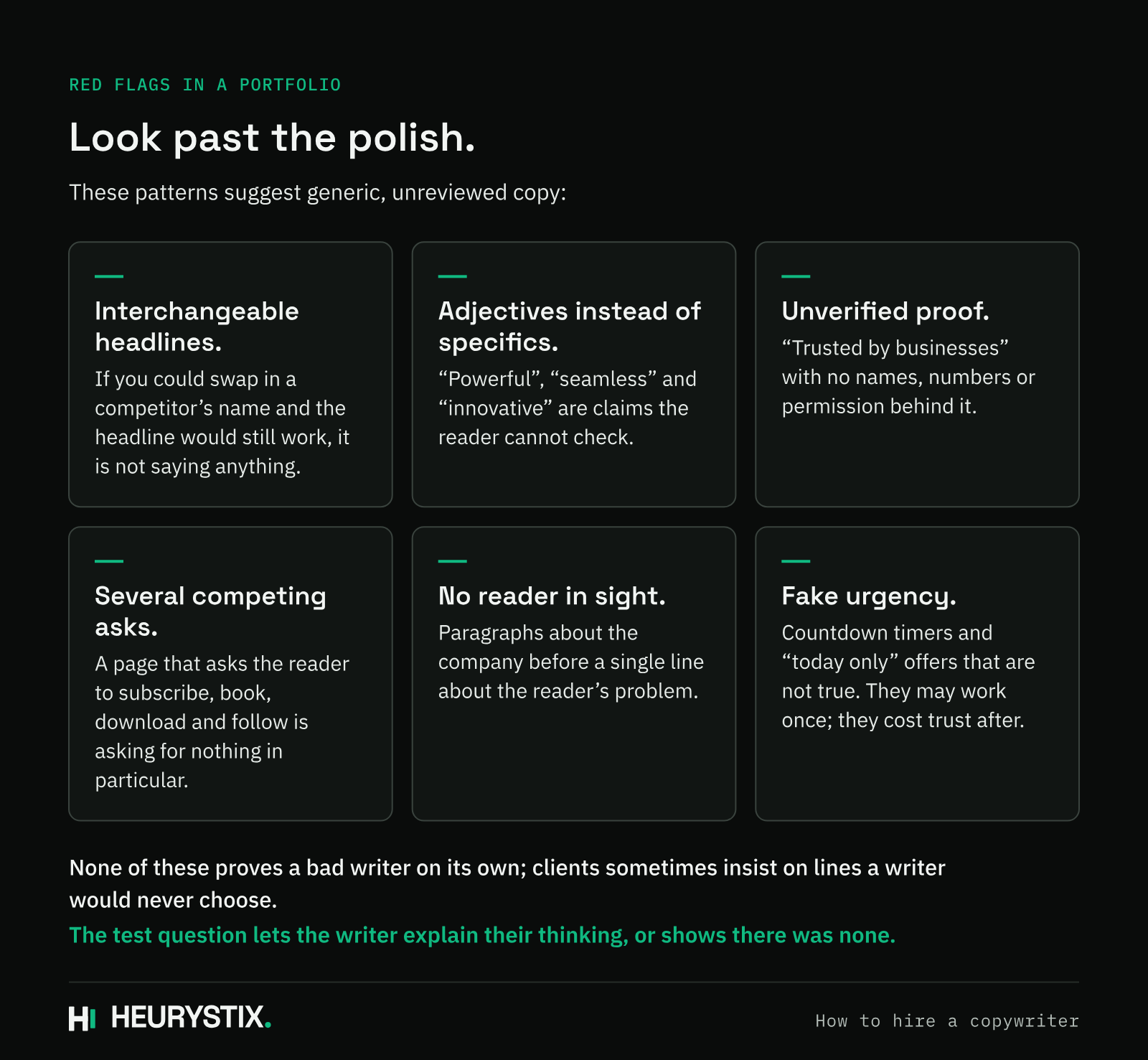
Look past the polish. These patterns suggest generic, unreviewed copy:
- Interchangeable headlines. If you could swap in a competitor's name and the headline would still work, it is not saying anything.
- Adjectives instead of specifics. "Powerful", "seamless" and "innovative" are claims the reader cannot check.
- Unverified proof. "Trusted by businesses" with no names, numbers or permission behind it.
- Several competing asks. A page that asks the reader to subscribe, book, download and follow is asking for nothing in particular.
- No reader in sight. Paragraphs about the company before a single line about the reader's problem.
- Fake urgency. Countdown timers and "today only" offers that are not true. In India, false urgency is a named dark pattern under the CCPA's 2023 dark patterns guidelines. It may work once; it costs trust after.
None of these proves a bad writer on its own; clients sometimes insist on lines a writer would never choose. The test question lets the writer explain their thinking, or shows there was none.
What to send them: a one-page copywriting brief template
Send every shortlisted candidate the same one-page brief. It makes proposals comparable and shows you who reads carefully. Here is a copywriting brief template you can copy: eight questions to answer.
- The decision. What should the reader do after reading?
- The reader. Who are they, what do they already know, and what do they believe about the problem?
- The doubt. What is the main reason they might not act today?
- The proof. What can you actually substantiate: customer names you have permission to use, data you can share, certifications, guarantees?
- The context. Where does the reader arrive from, such as an ad, an email or a search result, and what did that source promise?
- The constraints. What are the brand voice, the regulatory rules, the words you cannot use and the approval steps?
- The measure. Which single behaviour will tell you the copy worked?
- The deadline and format. When do you need it, and in what form: a document, annotated drafts, variants for testing?
Copywriting brief examples: one filled in
Copywriting brief examples help most when they are complete, so here is one. It is illustrative, about a made-up product, not client work.
- Decision: a finance controller starts a free trial of an accounts-payable tool.
- Reader: a controller at a mid-sized manufacturer who runs month-end close on spreadsheets and is not looking for software.
- Doubt: "Switching tools mid-year is risky, and our process works well enough."
- Proof: a working free trial, a GST-ready invoice format and an onboarding call. No customer logos yet.
- Context: arrives from a LinkedIn post about month-end close.
- Constraints: no unverifiable claims, plain English, and the product head approves all copy.
- Measure: trial starts from this page.
- Deadline and format: a first draft in a shared document, with the mechanism noted beside each section.
A brief like this answers a copywriter's first questions before they ask. The candidates who come back with sharper questions about the doubt are usually the ones worth hiring.
How copywriters scope the work: project or retainer
Copywriters usually scope work in one of two ways.
A project has a defined output: a landing page, a set of product pages, an email sequence. It suits a launch or an underperforming page. Agree upfront what the research covers and what counts as a change of scope.
A retainer covers an ongoing flow of copy. It suits teams that ship pages and campaigns every month and want writers who already know the product and the reader.
Some writers quote by the word or the page. Whatever the model, compare what is included. A short page can take more thinking than a long one.
At Heurystix, pricing is set per project or retainer after a first conversation, and every draft arrives annotated with its mechanisms. Conversion copy is one of several content and copy services we offer, alongside social media marketing.
FAQs: hiring a copywriter in India
How much does it cost to hire a copywriter in India?
It depends on scope: how many pages, how much research and how many review rounds. Ask each writer to scope against the same brief so you compare like with like, and see how copywriters charge for the models in detail. At Heurystix, pricing is set per project or retainer after a first conversation.
Should I hire a freelance copywriter or an agency?
Hire a freelancer when the job is contained and the decisions behind it are made. Choose an agency when you need several writers to one standard, or the strategy is still open.
Can I hire a copywriter for just one landing page?
Yes. A single page is a common first project and a good test of fit. Send the one-page brief above before they start.
Who owns the copy after I pay a copywriter in India?
Whoever the contract says, so put it in writing. Under the Copyright Act, 1957, the writer is the first owner of what they write, unless they wrote it as your employee in the course of their job (section 17). With a freelancer or an agency, the copyright passes to you through a written assignment signed by the writer (section 19). State the period and the territory: if the assignment leaves them out, the Act treats it as lasting five years and covering India only. Ask your lawyer to check the clause. This is general information, not legal advice.
Sources
- Allcott, H. (2011). Social norms and energy conservation. Journal of Public Economics, 95(9-10).
- Burger, J. M. (1999). The foot-in-the-door compliance procedure: a multiple-process analysis and review. Personality and Social Psychology Review, 3(4).
- Central Consumer Protection Authority (2023). Guidelines for Prevention and Regulation of Dark Patterns, 2023.
- Freedman, J. L. and Fraser, S. C. (1966). Compliance without pressure: the foot-in-the-door technique. Journal of Personality and Social Psychology, 4(2).
- Kahneman, D. and Tversky, A. (1979). Prospect theory: an analysis of decision under risk. Econometrica, 47(2).
- Schultz, P. W., Nolan, J. M., Cialdini, R. B., Goldstein, N. J. and Griskevicius, V. (2007). The constructive, destructive, and reconstructive power of social norms. Psychological Science, 18(5).
- The Copyright Act, 1957, sections 17 and 19.