Insights · Conversion content
Conversion copywriting examples, annotated by mechanism
Good conversion copy is not clever. Every line has a job, and you can name it.
Most lists of conversion copywriting examples show you a headline and call it good. That helps you admire the line. It does not help you write the next one, because it never says why the line works, or when the same move would fail.
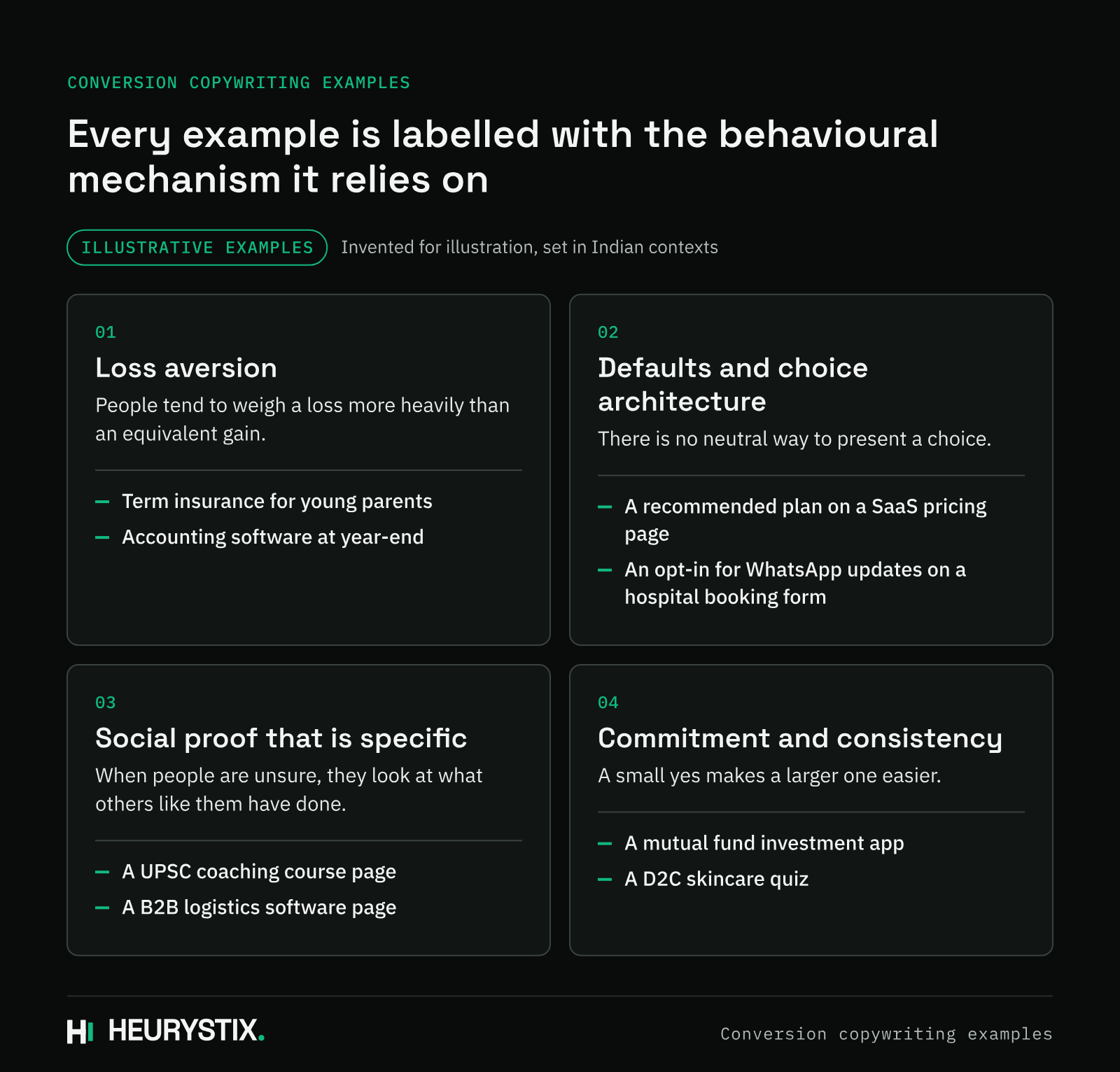
This post does it differently. Every example is labelled with the behavioural mechanism it relies on: loss aversion, defaults, social proof or commitment. Each one says why it works and where it backfires. It is the same way we annotate drafts in our own conversion copywriting work.
One rule before we start. Every example here is invented for illustration and set in Indian contexts such as insurance, SaaS, healthcare and education. None is taken from, or attributed to, a real brand, and none comes with results, because we will not claim results we cannot verify.
What is conversion copywriting (and what it isn't)
Conversion copywriting is copy written to move a reader to one specific action: book a call, start a trial, request a quote, complete a form. Every line on the page is chosen for the decision it supports.
It is not the same as content writing, which informs and builds trust over time. It is not slogan writing, which aims at memory. And it is not a bag of tricks. A page that fakes urgency or hides a default may lift clicks once, but it borrows against the reader's trust, and in India some of those tricks now run into regulation as well.
The test of conversion copy is behavioural. Did the reader do the thing? That is why the useful question about any line is not "do we like it?" but "which doubt does it answer, and how?"
How to read these examples: one mechanism per line
Text version
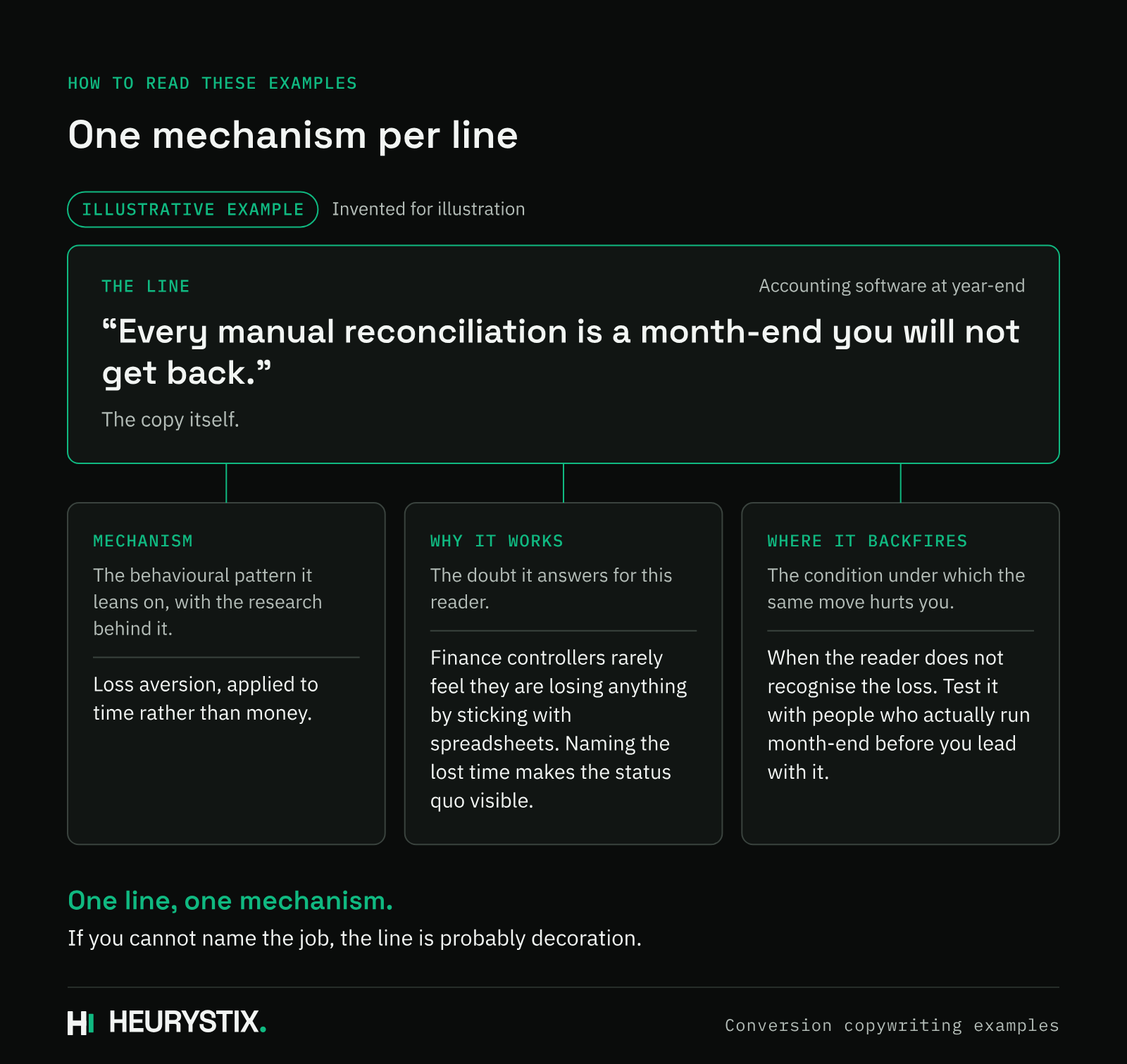
Each example below follows the same format:
- The line: the copy itself.
- Mechanism: the behavioural pattern it leans on, with the research behind it.
- Why it works: the doubt it answers for this reader.
- Where it backfires: the condition under which the same move hurts you.
One line, one mechanism. Real pages stack several mechanisms, but they work best when each line does one job. If you cannot name the job, the line is probably decoration.
We set out these mechanisms in more depth on our page about behavioural economics in marketing.
Loss aversion: headlines that name what the reader stands to lose
People tend to weigh a loss more heavily than an equivalent gain (Kahneman and Tversky, 1979). The same fact, framed as something avoided rather than something won, can change the choice people make (Tversky and Kahneman, 1981).
Term insurance for young parents
Illustrative example.
The line: "If your income stopped tomorrow, how long would your family's home loan wait?"
- Mechanism: loss aversion. It names a concrete loss the reader already worries about, instead of a generic gain such as "secure your future".
- Why it works: most term insurance pages talk about cover. This one talks about the thing cover protects, in the reader's own terms.
- Where it backfires: fear without a next step. If the page raises the loss and then buries the quote form under jargon, the reader leaves anxious, not convinced. Loss framing also has to be true; inflating a risk is not persuasion.
Accounting software at year-end
Illustrative example.
The line: "Every manual reconciliation is a month-end you will not get back."
- Mechanism: loss aversion, applied to time rather than money.
- Why it works: finance controllers rarely feel they are losing anything by sticking with spreadsheets. Naming the lost time makes the status quo visible.
- Where it backfires: when the reader does not recognise the loss. Test it with people who actually run month-end before you lead with it.
Defaults and choice architecture: pricing pages and forms
There is no neutral way to present a choice (Thaler and Sunstein, 2008). What is pre-selected, what is shown first and what is recommended all shape what people pick. Defaults are powerful precisely because many people stick with them (Johnson and Goldstein, 2003).
A recommended plan on a SaaS pricing page
Illustrative example.
The line: "Most growing CA practices start here" above the middle plan, with a short line under each plan on who it is for.
- Mechanism: choice architecture. A recommendation reduces the effort of comparing, and "who it is for" lets readers sort themselves.
- Why it works: buyers facing three similar plans often put the decision off. A clear recommendation makes one option the easy choice.
- Where it backfires: when "most" is not true. Only say it if your data supports it. Otherwise say "Recommended for practices with a growing client list", which is a recommendation, not a statistic.
An opt-in for WhatsApp updates on a hospital booking form
Illustrative example.
The line: "Send my appointment reminders on WhatsApp", with the box unticked and a note: "Only reminders and reports. No offers."
- Mechanism: an honest default. The box is off; the copy does the persuading by saying exactly what the reader gets.
- Why it works: patients want reminders but fear spam. Naming what will not be sent answers that fear.
- Where it backfires: pre-ticking it. A pre-ticked box may raise opt-ins, but it decides for the reader, and that is where a default starts to become a dark pattern. India's Central Consumer Protection Authority notified the Guidelines for Prevention and Regulation of Dark Patterns in 2023. They name false urgency and basket sneaking. Basket sneaking covers paid extras added at checkout without the user's consent, for example through a pre-ticked box. So invented countdowns and pre-selected paid add-ons carry legal risk as well as a trust cost.
Social proof that is specific
When people are unsure, they look at what others like them have done (Cialdini, 1984). Telling people what their peers actually do has shifted behaviour in field studies, such as household energy use (Schultz et al., 2007; Allcott, 2011). The lesson for copy: proof from people the reader recognises as like them carries more weight than praise from anyone.
A UPSC coaching course page
Illustrative example.
The line: a testimonial that reads, "I was working full-time in Pune and studying after nine at night. The recorded doubt-clearing sessions were the only reason I could keep up." Attributed with a first name, city and the year the student attempted the exam, with their permission.
- Mechanism: social proof from someone like the reader.
- Why it works: a working aspirant reading this sees their own constraint answered by someone in the same position. A generic "Best faculty in India" answers nothing.
- Where it backfires: when it is unverifiable. Testimonials need real people and real permission. The ASCI Code requires advertising claims to be truthful and capable of substantiation, and requires permission before an ad refers to a person in a way that gains from them (Chapter I, clauses 1.1 and 1.3). One true, specific story beats ten vague ones.
A B2B logistics software page
Illustrative example.
The line: "Built with dispatch managers in Bhiwandi warehouses, not in a boardroom."
- Mechanism: social proof by association: the product was shaped by people like the reader.
- Why it works: it signals relevance to a sceptical operations buyer without a single number.
- Where it backfires: if it is not true. Only claim the involvement you can describe in detail if a prospect asks.
Commitment and consistency: small first steps
People like to stay consistent with what they have already said and done, so a small yes can make a larger one easier. The foot-in-the-door effect was first reported by Freedman and Fraser (1966); later reviews found it real but modest, and dependent on how the first request is framed (Burger, 1999). Use small first steps because they lower effort, and do not expect them to work on their own.
A mutual fund investment app
Illustrative example.
The line: "Answer four questions to see which kind of fund suits your goal. No PAN needed yet."
- Mechanism: commitment through a small first step (foot-in-the-door), with the bigger ask clearly deferred. The effect is real but modest, and depends on how the first request is framed (Freedman and Fraser, 1966; Burger, 1999).
- Why it works: a first-time investor is not ready to share documents. They are ready to answer a few questions about a goal. Having done that, the next step feels like continuing, not starting.
- Where it backfires: if the "four questions" become twelve, or the results page demands a phone number before showing anything. Breaking a small promise breaks the sequence. In regulated categories, the output also has to stay within what the rules allow you to suggest.
A D2C skincare quiz
Illustrative example.
The line: "Tell us about your skin in a minute. We'll show you a routine, not a basket."
- Mechanism: commitment, plus a reassurance that the step is not a sales trap.
- Why it works: it names the reader's suspicion and answers it in the same line.
- Where it backfires: when the routine page is a basket after all.
Before and after: three landing page copy rewrites
The best landing page copywriting examples show the reasoning, not just the polish. These are illustrative landing page copy examples. Each rewrite changes the decision the page asks for, not just the words.
Rewrite one: home loan balance transfer
Illustrative example.
Text version
| Before | After | |
|---|---|---|
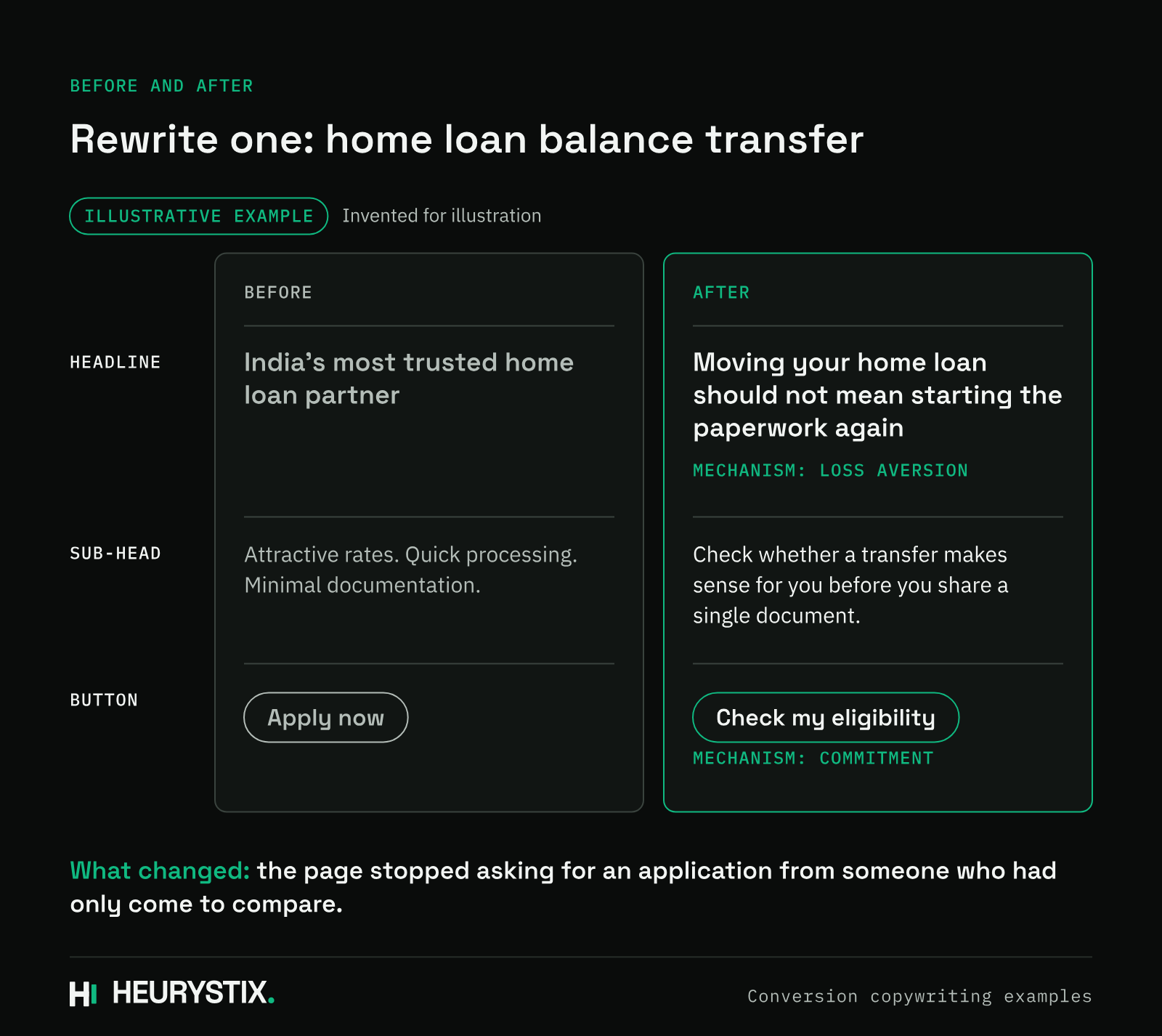
| Headline | India's most trusted home loan partner | Moving your home loan should not mean starting the paperwork again |
| Sub-head | Attractive rates. Quick processing. Minimal documentation. | Check whether a transfer makes sense for you before you share a single document. |
| Button | Apply now | Check my eligibility |
- Mechanisms: loss aversion in the headline (the paperwork the reader dreads), commitment in the button (a small first step).
- What changed: the page stopped asking for an application from someone who had only come to compare.
Rewrite two: GST invoicing software trial
Illustrative example.
| Before | After | |
|---|---|---|
| Headline | Next-gen invoicing for modern businesses | Raise GST-ready invoices without opening a spreadsheet |
| Proof | Trusted by thousands | A short quote from a named small-business owner, used with permission |
| Under the button | Nothing | No card needed. Your data exports any time. |
- Mechanisms: specific social proof; loss aversion addressed directly, since the fear of being locked in is answered under the button.
- What changed: the copy now answers "what happens if I leave?", a common doubt before anyone starts a trial.
Rewrite three: preventive health check package
Illustrative example.
| Before | After | |
|---|---|---|
| Headline | Comprehensive health check packages | A health check for your parents, booked in one call, with reports explained in plain language |
| Choice | Six packages in a grid | Three packages, with one marked "Suggested for parents over sixty" and why |
| Button | Book now | Book for my parents |
- Mechanisms: choice architecture (fewer options, one recommended), identity in the button (the caring child, not the patient).
- What changed: the page now speaks to the person who actually books the test.
If you are weighing whether to commission this kind of rewrite, our guides on how to hire a copywriter and how copywriters charge cover what to ask and how the work is scoped.
FAQs: conversion copywriting examples
What is conversion copywriting?
Copy written to move a reader to one specific action, such as booking a call or starting a trial, where every line is chosen for the decision it supports.
How is conversion copywriting different from content writing?
Content writing informs and builds trust over time. Conversion copywriting is judged on whether the reader acts on that page.
Are these real examples?
No. Every example is an illustrative example, invented for illustration and set in Indian contexts. None is taken from, or attributed to, a real brand. We describe the mechanism, not results we cannot verify.
How do I apply this to my own landing page?
Pick the one decision the page asks for, name the mechanism each section uses, and rewrite any line that has no job.
Want your landing page rewritten line by line? A first conversation with a founder is the place to start.
Sources
- Allcott, H. (2011). Social norms and energy conservation. Journal of Public Economics, 95(9-10).
- Burger, J. M. (1999). The foot-in-the-door compliance procedure: a multiple-process analysis and review. Personality and Social Psychology Review, 3(4).
- Central Consumer Protection Authority (2023). Guidelines for Prevention and Regulation of Dark Patterns, 2023.
- Cialdini, R. B. (1984). Influence: the psychology of persuasion. William Morrow.
- Freedman, J. L. and Fraser, S. C. (1966). Compliance without pressure: the foot-in-the-door technique. Journal of Personality and Social Psychology, 4(2).
- Johnson, E. J. and Goldstein, D. (2003). Do defaults save lives? Science, 302(5649).
- Kahneman, D. and Tversky, A. (1979). Prospect theory: an analysis of decision under risk. Econometrica, 47(2).
- Schultz, P. W., Nolan, J. M., Cialdini, R. B., Goldstein, N. J. and Griskevicius, V. (2007). The constructive, destructive, and reconstructive power of social norms. Psychological Science, 18(5).
- Thaler, R. H. and Sunstein, C. R. (2008). Nudge: improving decisions about health, wealth, and happiness. Yale University Press.
- The Advertising Standards Council of India. The Code for Self-Regulation of Advertising Content in India, Chapter I.
- Tversky, A. and Kahneman, D. (1981). The framing of decisions and the psychology of choice. Science, 211(4481).